
4 Costly Greasing Mistakes: Stop Overlooking Your Components
Most bearing and joint failures are preventable. Here are the four most common maintenance mistakes — and how to fix them before it's too late.
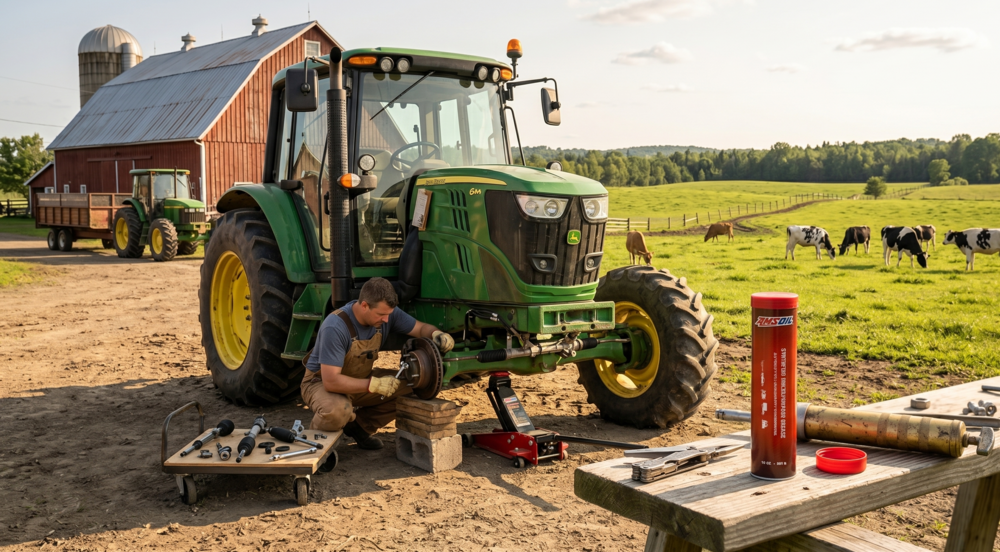
A tractor bearing, a steering tie-rod, a trailer axle — these components can last tens of thousands of hours when properly maintained, or wear out in weeks when they aren't. According to AMSOIL experts, four mistakes show up over and over in failure diagnoses. Before each season of intensive work, here's what you need to know to avoid these pitfalls.
Mistake #1 — Using the wrong type of grease
Not all greases are equal. A generic multi-purpose grease on a trailer bearing submerged in salt water breaks down in days. A standard lithium grease in a high-speed alternator melts and leaks out. The right choice depends on four main criteria:
- Application type — rolling bearing, pivot point, open gear
- Environment — dry, wet, submerged, dust-exposed
- Load — light, heavy, impact
- Speed — low, moderate, high
The how to choose the right industrial grease guide details the best practices. For most general applications, Multi-Purpose Grease GLC covers 80% of needs.
Mistake #2 — Mixing incompatible greases
Here's a silent mistake, because it doesn't show up immediately: switching brands or formulations without purging the old grease. Thickeners used in greases are chemically distinct. The main types are:
- Lithium soap — the most common
- Lithium complex — improved high-temperature performance
- Calcium sulfonate complex — superior water resistance
- Polyurea — used in sealed electric motors
- Polymeric — superior chassis adhesion
Mixing a lithium with a calcium sulfonate, for example, can create a hardened mass that blocks fresh grease, or alternatively a liquid mixture that runs out of the bearing. In both cases, the component is no longer protected.
The rule: before changing products, dismantle and clean mechanically. On Zerk fittings, pump in fresh grease until the purged grease is perfectly clean and the new color.
Mistake #3 — Tolerating contamination
Three main contaminants ruin even a well-chosen grease:
- Water — rusts metal surfaces, dilutes grease, creates abrasive micro-bubbles
- Dust and dirt — act like sandpaper between moving surfaces
- Metal particles — wear fragments that accelerate further wear
Three simple habits prevent contamination:
- Clean the Zerk fitting before each greasing — a rag wipe is enough
- Never use a dirty grease gun — the gun tip and nozzle must be clean
- Store cartridges dry and cap opened cartridges
For particularly hostile environments (construction sites, agriculture in wet season), Water-Resistant Grease GWR adds an extra safety margin.
Mistake #4 — Over-greasing or under-greasing
Many people think "more grease is better." It's not. An over-greased bearing operates under internal pressure, generates excessive heat, and can blow its seals. Conversely, an under-greased bearing runs dry, and wear is immediate.
A few practical rules:
- Follow the manufacturer's recommendations — precise number of pump strokes
- Grease until old grease emerges, then stop
- Establish a maintenance schedule and stick to it
- Keep a log — date, number of strokes, observations on purged grease
For truck chassis and heavy equipment, Polymeric Grease GPTR2 has the advantage of staying in place longer, extending the interval between greasings.
NLGI grade: the detail that changes everything
The NLGI grade defines grease consistency, from 000 (very fluid) to 6 (very stiff). A wrong grade turns an excellent grease into a poor choice:
- NLGI 0 — open gears, centralized systems
- NLGI 1 — extreme cold applications (down to -40°C), truck chassis
- NLGI 2 — general purpose, most industrial bearings
- NLGI 3 — high speed, high temperature, critical sealing
Summary: the 4 mistakes to avoid
- Choosing the wrong grease for the actual application
- Mixing incompatible greases without purging
- Tolerating contamination by water, dust or particles
- Over-greasing or under-greasing outside recommendations
Regular inspection of greased components — before any period of heavy use — often reveals a problem in its early stages, well before it becomes an immobilizing breakdown. A visual check of purged grease at every fitting remains one of the simplest and most effective ways to spot trouble before it gets expensive.