
NLGI 00 to 6, GC-LB: Understanding Grease Grades
A grease label carries several numbers and codes — NLGI 2, GC-LB, ISO VG 220. Each measures something different. Here's how to read them, and why a higher number doesn't mean a "thicker" grease.
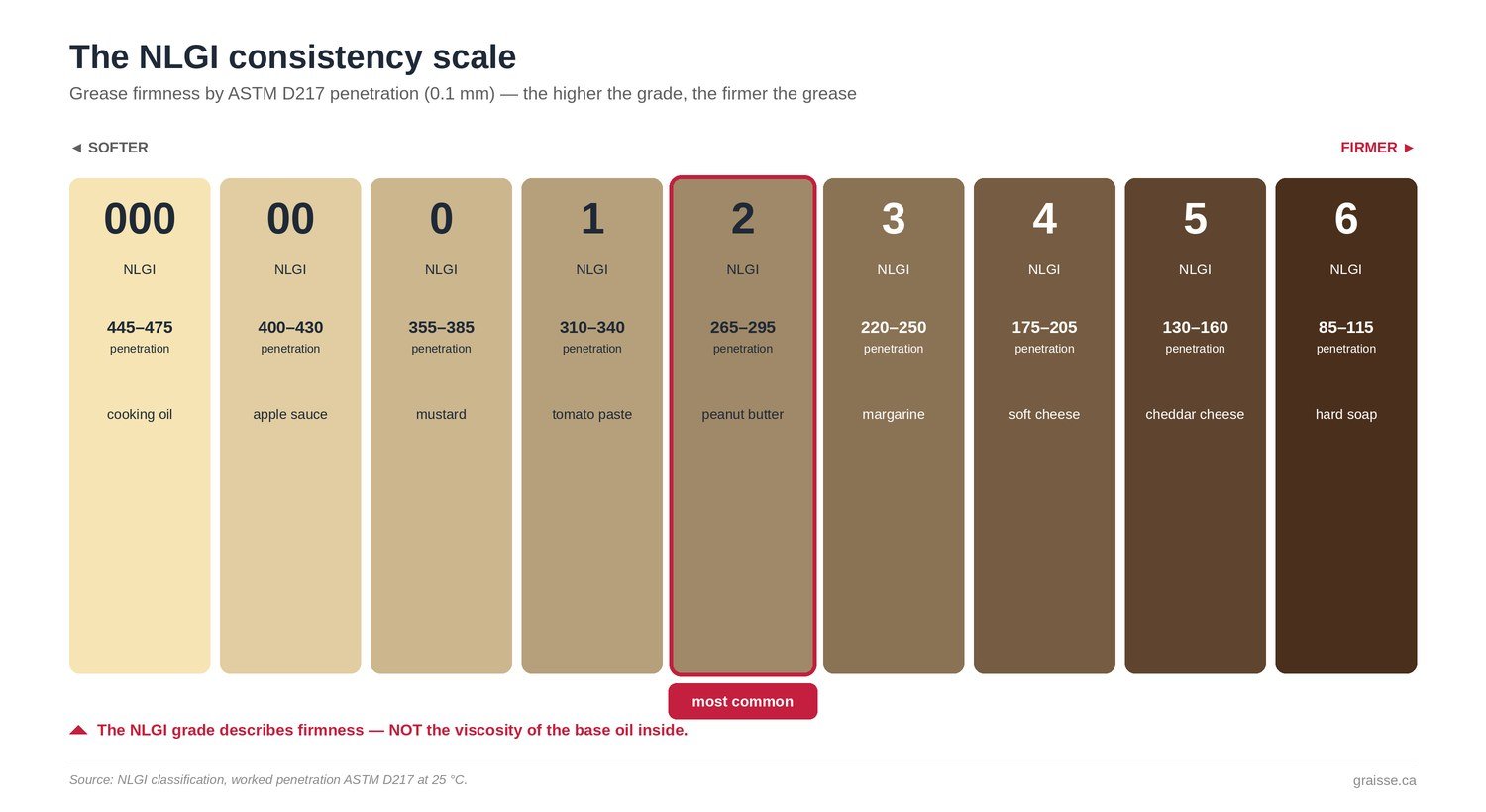
Grease isn't just "thick oil." It's a base oil held in a thickener matrix (a soap), with additives. As a result, describing it properly takes three separate pieces of information, each governed by its own logic: consistency, performance, and base oil. People routinely confuse the three — and that's where bad choices begin.
1. NLGI consistency: how firm the grease is
The National Lubricating Grease Institute (NLGI) classifies greases by consistency — their firmness — on a scale from 000 (almost liquid) to 6 (block-hard). The grade is set by ASTM D217 worked penetration: a standard cone is dropped into the grease and its depth is measured in tenths of a millimetre. The deeper the cone sinks, the softer the grease, and the lower the NLGI number.
| NLGI grade | Penetration (0.1 mm) | Consistency | Typical use |
|---|---|---|---|
| 000 / 00 | 400–475 | semi-fluid | gear cases, centralized systems |
| 0 / 1 | 310–385 | soft | centralized systems, extreme cold |
| 2 | 265–295 | "peanut butter" | the standard: bearings, chassis, general use |
| 3 | 220–250 | firm | high-speed bearings, vertical positions |
| 4 to 6 | 85–205 | very firm to hard | specialized applications, blocks |
NLGI 2 is by far the most common — the "peanut butter" consistency that suits most bearings and grease points. But remember this above all: the NLGI grade describes only firmness. It says nothing about the oil inside.
2. The myth to bust: consistency ≠ oil thickness
"A firmer grease protects heavier loads." Not necessarily.
A grease's firmness comes from its thickener (lithium soap, calcium, a complex, polyurea…) — much like the sponge that holds water. Load-carrying capacity, on the other hand, depends mostly on the viscosity of the base oil trapped in that sponge — it's that oil that actually forms the film between metal surfaces.
In practice: two greases both rated NLGI 2 can contain radically different base oils — one thin for a high-speed electric-motor bearing, the other very viscous for a slow, heavily loaded excavator pin. Same firmness to the finger, opposite behaviour in service. Reaching for a "firmer grease to be safe" fixes nothing if the base oil isn't right.
3. The performance rating: GC-LB (and beyond)
The NLGI grade tells you the firmness, not the quality. For that, the automotive industry uses the ASTM D4950 classification, better known by its codes:
- "LB" — chassis lubrication. "LB" is the most severe level of this category.
- "GC" — wheel bearings, exposed to braking heat. "GC" is the most severe level.
- "GC-LB" — the grease meets both highest levels. The best assurance for a general-purpose automotive grease.
For industry, a newer and more demanding standard exists: the NLGI HPM standard, with its load, water and corrosion tests and its variants (WR, LT, HL, CR). We cover it in our dedicated article: the NLGI HPM standard, explained.
4. Base-oil viscosity: the hidden number that matters
It's the most often ignored parameter, yet a decisive one. The base-oil viscosity (expressed as ISO VG, for example 100, 220, 460) determines:
- Allowable speed — high-speed bearings need a thinner base oil to avoid overheating.
- Load and slow speed — slow, heavily loaded pins (buckets, joints) need a more viscous base oil to keep the film.
- Temperature range — combined with the NLGI grade, it decides cold and hot behaviour.
That's why AMSOIL offers, for example, a high-viscosity lithium-complex grease (GVC) for heavy, slow loads, distinct from a multi-purpose grease with a lighter base oil. Same family, opposite base oils.
5. The three systems together
None of the three pieces is enough on its own. You choose the right grease by reading them together:
| Information | Answers the question |
|---|---|
| NLGI grade (000–6) | How firm is the grease? |
| GC-LB / HPM | What performance level has it proven? |
| Base-oil viscosity (ISO VG) | Does it suit my speed and load? |
The practical shortcut: the equipment manual gives the recommended NLGI grade and often the base-oil viscosity. Start there — never the other way around.
What it changes in Québec
Cold changes everything. An NLGI 2 that's perfect in summer can become too firm at −30 °C: it no longer pumps through a centralized system and distributes poorly at start-up — exactly when the bearing needs it most. A synthetic NLGI 1 grease, or an NLGI 2 formulated for low temperatures, stays supple where a mineral grease seizes. We discuss it in synthetic grease in extreme cold and in our Québec winterization guide.
For an agricultural, forestry or industrial operator, the right grade in the right place means fewer re-greasing runs, less wear and less downtime. The wrong grade doesn't show right away — it shows up as the bearing that fails.
Frequently asked questions
Is an NLGI 2 grease "thicker" than an NLGI 1?
It's firmer, not necessarily made with a more viscous oil. Firmness comes from the thickener; base-oil viscosity is a separate parameter. Two NLGI 2 greases can behave very differently.
What is the GC-LB rating?
The ASTM D4950 automotive service classification: "GC" for wheel bearings, "LB" for chassis, at the most severe levels. GC-LB meets both — the best assurance for a general-purpose automotive grease.
Why does base-oil viscosity matter?
The base oil forms the lubricating film. Low viscosity for high speed, high viscosity for heavy, slow loads. Two greases of the same NLGI grade can have opposite base oils.
Which NLGI grade for extreme cold?
In very cold weather, an NLGI 2 can become too firm. A synthetic NLGI 1 (or a low-temperature NLGI 2) stays pumpable and distributes well at start-up.
How do I know which grade my equipment needs?
The manufacturer's manual gives the NLGI grade, performance rating and often the base-oil viscosity. When in doubt, call us at 819-519-7772 ext. 3.
In short: decoding a grease label
- The NLGI grade (000–6) = firmness, measured by ASTM D217 penetration. NLGI 2 = the standard.
- The NLGI grade says nothing about the base oil: consistency ≠ oil thickness.
- GC-LB (ASTM D4950) = the automotive performance level; HPM = the industrial benchmark.
- Base-oil viscosity (ISO VG) decides the allowable speed and load.
- Read all three together — and always start from the equipment manual.
Read correctly, a grease label removes the guesswork. Read wrong, it leads to a bearing that overheats or a grease that seizes. If you're unsure about the grade or formulation for a specific piece of equipment, we'll check it with you, spec by spec.